NPU-CPU LLM Inference
Furiosa RNGD NPU + Intel AMX cooperative inference for Llama 3.1 8B
By the collaboration of Elijah Ye and Frey Zhao
UIUC ECE527 FA25 | August 2025 ~ December 2025
For the benchmark code, please see the project github repository at this link.
Overview
High-end GPUs are expensive to buy and run, with TDPs of 300-700W. This project explores NPU-CPU cooperative computing, pairing the Furiosa RNGD NPU (180W TDP) with Intel Advanced Matrix Extensions (AMX) on Sapphire Rapids as a power-efficient alternative to GPU-only inference of Llama 3.1 8B.
I led the project and designed an analytical performance model that partitions inference between the NPU and the CPU by arithmetic intensity and batch size, predicting end-to-end latency from measured component latencies.
Adaptive Partitioning Policies
- Policy 1 (CPU-only, small batch): CPU with AMX computes all layers. Best for batch size 1 thanks to 20× faster model loading.
- Policy 2 (hybrid, medium batch): CPU handles memory-bound operations and the NPU handles compute-bound ones. Only 12% average latency degradation vs. H100 at batch sizes 4 and 16, with 2.6× lower total system power (330W vs 850W).
- Policy 3 (NPU-only, large batch): 16.8% degradation at batch size 64 with 3.9× lower accelerator power.
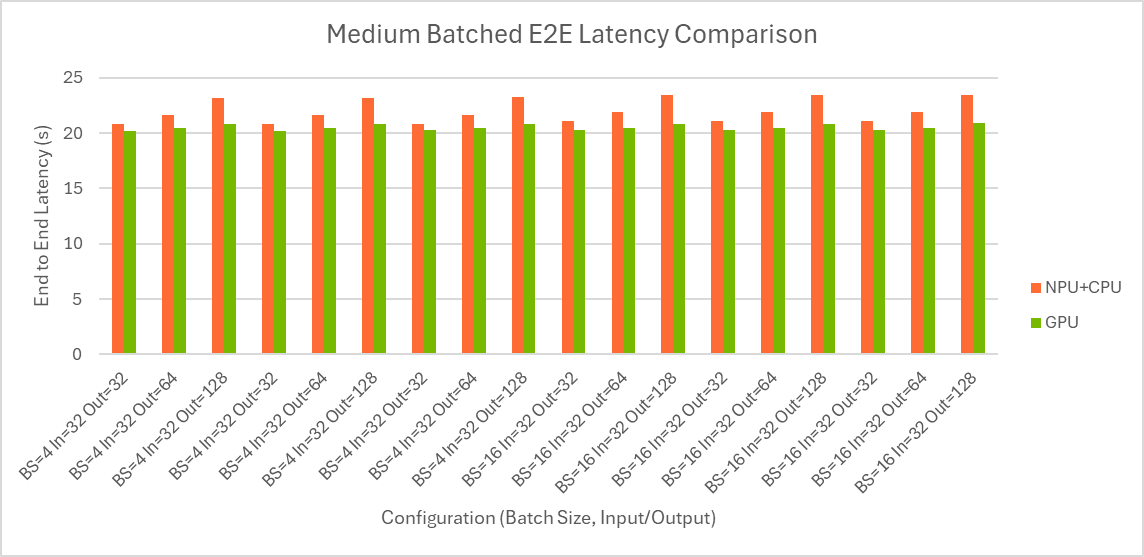
Results
Overall, the NPU-CPU system delivers 2× better power efficiency than GPU-only systems, and a three-year total cost of ownership analysis projects 23-40% lower cost than H100-based systems.